En el último número de la revista PNAS se ha publicado un artículo de investigadores del Instituto Jacques Monod de París que apuntan como los métodos normales de preparación de fósiles, destruye y contamina al ADN que pudieran tener los ejemplares. Estos autores apuntan al lavado como uno de los principales problemas, al contaminar con ADN actual a los fósiles.
La referencia es: Pruvost M., et al. PNAS, doi: 10.1073/pnas.0610257104 (2007).
Más información en: http://www.nature.com/news/2007/070108/full/070108-2.html

sábado, enero 13, 2007


Homo sapiens llego a Europa por Rusia hace 45000 años
Un articulo publicado en el último número de Science apunta que el hombre moderno entro en Europa desde Asia hace al menos 45.000 años. El estudio se basa en el descubrimiento de adornos personales y marfil tallado en un yacimiento de hace 45.000 años situado al sur de Moscú. Hasta este momento se suponía que la migración a Europa se había realizado mucho más al sur. Además los instrumentos encontrados en Rusia son diferentes a los encontrados en otros yacimientos europeos, lo que sugiere que hubo distintas poblaciones emigrantes
La referencia es: Early Upper Paleolithic in Eastern Europe and Implications for the Dispersal of Modern Humans. M. V. Anikovich, A. A. Sinitsyn, John F. Hoffecker, Vance T. Holliday, V. V. Popov, S. N. Lisitsyn, Steven L. Forman, G. M. Levkovskaya, G. A. Pospelova, I. E. Kuz'mina, N. D. Burova, Paul Goldberg, Richard I. Macphail, Biagio Giaccio, and N. D. Praslov. Se puede consultar en: http://www.sciencemag.org/cgi/content/abstract/315/5809/223?etoc[27]
Más información en: http://www.elpais.com/articulo/sociedad/estudio/sugiere/hombre/moderno/llego/Europa/Asia/hace/45000/anos/elpepusoc/20070112elpepusoc_2/Tes
La referencia es: Early Upper Paleolithic in Eastern Europe and Implications for the Dispersal of Modern Humans. M. V. Anikovich, A. A. Sinitsyn, John F. Hoffecker, Vance T. Holliday, V. V. Popov, S. N. Lisitsyn, Steven L. Forman, G. M. Levkovskaya, G. A. Pospelova, I. E. Kuz'mina, N. D. Burova, Paul Goldberg, Richard I. Macphail, Biagio Giaccio, and N. D. Praslov. Se puede consultar en: http://www.sciencemag.org/cgi/content/abstract/315/5809/223?etoc[27]
Más información en: http://www.elpais.com/articulo/sociedad/estudio/sugiere/hombre/moderno/llego/Europa/Asia/hace/45000/anos/elpepusoc/20070112elpepusoc_2/Tes
viernes, enero 12, 2007
Conferencia de Lynn Margulis en Zaragoza

El próximo Miércoles, 17 de Enero de 2007 a las 18 horas en el Salón de Actos, Edificio Ada Byron, CPS (Universidad de Zaragoza), la profesora Lynn Margulis va a impartir una charla con el título REVOLUCIÓN EN LA EVOLUCIÓN. Desde el CPS nos han enviado el siguiente mensaje
El Ateneo del CPS se honra en recibir a uno de los científicos más destacados de la actualidad, posiblemente la mujer más influyente en las ciencias biológicas a nivel mundial. Tan sólo en su calidad de creadora de la Teoría Simbiótica sobre el origen de las células complejas (eucariotas), en los años 70, corroborada luego en multitud de trabajos experimentales, Lynn Margulis ha cambiado de un modo irreversible la biología de nuestro tiempo. El dominio indiscutido del darwinismo reduccionista ha dejado paso a la búsqueda de modelos más sofisticados e integradores sobre la competencia/colaboración en la evolución de las especies. La propia Lynn ha contribuido, a través de la Teoría GAIA (propuesta junto a James Lovelock), a una nueva visión acerca de cómo el conjunto de especies de la Biosfera integrarían un organismo global con propiedades emergentescuasi-cibernéticas a nivel planetario. En esta época nuestra que demanda una nueva articulación de la ciencia, la tecnología y las actividades económicas para con las realidades de la Naturaleza, el pensamiento de Lynn Margulis supone una poderosa fuente de inspiración.
La Doctora Lynn Margulis es Distinguished Professor, University of Massachusetts-Amherst. Pertenece a a la National Academy of Sciences (USA)
y a la Russian Academy of Natural Science. Además Tiene la National Medal of Science
Una charla imprescindible para los que estudiosos de la evolución
Patrimonio Geologico de Extremadura
La Consejería de Agricultura y Medio Ambiente de la Junta de Extremadura ha editado un interesante libro sobre el patrimonio geológico de Extremadura. Está coordinado por Pedro Muñoz Barco y Esperanza Martínez Flores.
Hay más información y se pueden descargar los capítulos en pdf en la Web Agralia: El http://aym.juntaex.es/medioambiente/actualidad/libro_patrimonio.htm
Hay más información y se pueden descargar los capítulos en pdf en la Web Agralia: El http://aym.juntaex.es/medioambiente/actualidad/libro_patrimonio.htm
Tsaagan: un nuevo teropodo de Mongolia

Nuestros colegas del Natural Museum of Natural History de Nueva York han publicado un nuevo terópodo dromaeosaurido de Mongolia en la revista American Museum Novitates. Lo han nombrado con el Tssagan mangas, y se trata de un cráneo bien conservado y una serie vertical. El ejemplar proviene de la misma formación (Djadokhta Formation) en que se encuentra Velociraptor mongoliensis.
La referencia completa es: Norell, M. A., Clark, J. M., Turner, A. H., Makovicky, P. J., Barsbold, R. & Rowe, T. 2006. A new dromaeosaurid theropod from Ukhaa Tolgod (Ömnögov, Mongolia). American Museum Novitates, 3545, 1-51.
El artículo completo se puede descargar en: http://digitallibrary.amnh.org/dspace/bitstream/2246/5823/1/N3545.pdf
La conexion Portugal-USA en el Jurasico Superior
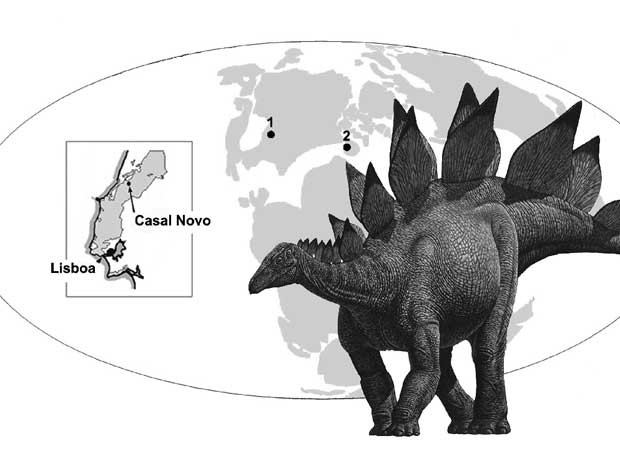
La revista Naturwissenschaften acaba de publicar un interesante trabajo que demuestra la conexión biogeográfica entre la Península Ibérica y el Centro de los Estados Unidos en el Jurásico Superior. Se trata del descubrimiento de restos de Stegosaurus ungulatus en Portugal, que son la primera prueba de la presencia de este dinosaurio estegosaurio en Europa. El ejemplar proviene del yacimiento de Casal Novo y se han descubierto placas dorsales, tibia y dientes. Para los autores del trabajo la fauna de Iberia no era distinta del resto de las islas que conformaban el archipielago europeo y de Norteamérica, dicho de otra manera consideran que no existía endemismos y había una destacable relación faunística a pesar de la presencia de mares y oceanos.
El trabajo está firmado por un equipo hispano-portugues. La referencia completa es: Fernando Escaso, Francisco Ortega, Pedro Dantas, Elisabete Malafaia, Nuno L. Pimentel, Xabier Pereda-Suberbiola, José Luis Sanz, José Carlos Kullberg, María Carla Kullberg and Fernando Barriga: New evidence of shared dinosaur across Upper Jurassic Proto-North Atlantic: Stegosaurus from Portugal
Más información (incluyendo el dibuejo) en: http://www.elpais.com/articulo/futuro/primer/estegosaurio/Europa/elpepusocfut/20070110elpepifut_5/Tes
El artículo se puede descargar: https://www.springerlink.com/content/ru4844423255jj22/resource-secured/?target=fulltext.pdf
jueves, enero 11, 2007
El Dinosaurio mas grande de los grandes
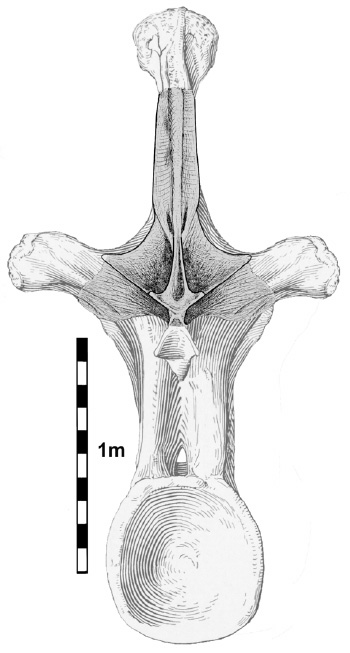
Las discusiones sobre los dinosaurios más grandes suelen olvidarse del mayor ejemplar de todos como es el arco neural de 1,5 metros de altura descubierto en 1878 en la Formación Morrison del Centro de EE.UU. Esta vértebra fue descrita como Amphicoelias fragillimus por E. D. Cope y recientemente ha sido reestudiada por Kenneth Carpenter. Estima que pertenecería a un diplodocido de 58 metros de longitud y una masa de 122400 kg. Lo que le hace afirmar que representa el pico conocido en gigantismo en saurópodos. En la fotografia se muestra la reconstrucción realizada por Carpenter
La referencia completa es:
Carpenter, K. 2006. Biggest of the big: A critical re-evaluation of the mega-sauropod Amphicoelias fragillimus Cope, 1878. Foster, J. R. & Lucas, S. G. R. M., eds. Paleontology and Geology of the Upper Jurassic Morrison Formation. New Mexico Museum of Natural History and Sciences Bulletin, 36, 131-138.
La edad del Gran Cañón del Rio Colorado
...que pasa por Colorado y New Mexico, conocido cariñosamente como el Gran Cañón o Grand Canyon
Para que veais que para denunciar algo hay que conocerlo a fondo:
In response to the email and web page on the age of the Grand Canyon I would like to share my experience at the Grand Canyon this summer. I was part of the Geological Society of America’s GeoCorp program that places geologist in National Parks for 3 month terms. I was selected to work on the new Yavapai Point Museum at the Grand Canyon Nation Park, South Rim. The museum will focus exclusively on the geology of the Grand Canyon. GSA paid me a stipend for the first 3 months I worked there and I was considered a volunteer by the National Park Service (NPS). My stay was extended for a month and a half and during this time I was hired by the NPS as an interpretive park ranger and was paid a salary by the NPS. I was part of a 4 person team that worked on the museum exhibits including writing the text. At no time was I told what to say or not to say to park visitors by either my supervisors or any member of the team. In the museum’s exhibits the age of the canyon is discussed as well as the age of the rocks both relative ages and radiometric ages. No mention is given to creationism or an alternative non-scientific age to the canyon. The exhibit’s text cites the age of the canyon ~ 6 million years old. There is a section on how the carving of the canyon is dated by the 11 to 6 million years old Hualapai Limestone (no river gravels) and the 4.41 million year old Sandy Point Basalt (resting on top of river gravels). There are small exhibits on relative dating, radiometric dating, and fossil correlation. There is an exhibit with the title “A Look into Deep Time” that uses an encyclopedia with 1 page equal to 1 million years as its center piece. The encyclopedia is 4,540 pages thick. The exhibit should be installed during May 2007.
I attended many ranger lectures, evening programs, and trailside tours and most of them mentioned the age of the canyon and rocks even if the talk was not about geology. EVERY geology talk I attended mentioned the age of the Canyon and its rocks. Some ranger talks mention local Indian beliefs about the canyon and its formation but it was not presented as a scientific theory. Most rangers took questions from the audience and I never heard a ranger answer “no comment”. Two rangers (one with a Masters of Science degree in geology) published a 3 page pamphlet on the age of the canyon and its formations and also published and have for sale in the parks gift shop a meter stick/ time stick with the age of the Earth and age of the Grand Canyon and its rock formations.
The Grand Canyon National Park is also working with the University of New Mexico on a Trail of Time that will have brass tick marks (1 meter apart) imbedded into the main rim trail that runs between the hotels and the new geology museum. Each tick mark will represent 1 million years and at key points small plaques will be placed identifying times when different geological processes occurred. In Summary I did not see any attempt to conceal from the public the age of the canyon or how it formed.
Paul Mayer. University of Wisconsin - Madison (pmayer@geology.wisc.edu)
From: Theropod Reply-To: "A listserver system for paleontologists."
To: PaleoNet Subject: Paleonet: Debate over the age of the Grand Canyon. Date: Fri, 29 Dec 2006 11:02:03 -0700
Dan Chure: The following story may be of general interest to earth scientists. More details can be obtained at the website http://www.peer.org/news/news_id.php?row_id=801
*HOW OLD IS THE GRAND CANYON? PARK SERVICE WON’T SAY* — Orders to Cater to Creationists Makes National Park Agnostic on Geology
Washington, DC — Grand Canyon National Park is not permitted to give an official estimate of the geologic age of its principal feature, due to pressure from Bush administration appointees. Despite promising a prompt review of its approval for a book claiming the Grand Canyon was created by Noah's flood rather than by geologic forces, more than three years
later no review has ever been done and the book remains on sale at the park, according to documents released today by Public Employees for Environmental Responsibility (PEER).
“In order to avoid offending religious fundamentalists, our National Park Service is under orders to suspend its belief in geology,” stated PEER Executive Director Jeff Ruch. “It is disconcerting that the official position of a national park as to the geologic age of the Grand Canyon is ‘no comment.’”
In a letter released today, PEER urged the new Director of the National Park Service (NPS), Mary Bomar, to end the stalling tactics, remove the book from sale at the park and allow park interpretive rangers to honestly answer questions from the public about the geologic age of the Grand Canyon. PEER is also asking Director Bomar to approve a pamphlet,
suppressed since 2002 by Bush appointees, providing guidance for rangers and other interpretive staff in making distinctions between science and religion when speaking to park visitors about geologic issues.
In August 2003, Park Superintendent Joe Alston attempted to block the sale at park bookstores of Grand Canyon: A Different View by Tom Vail, a book claiming the Canyon developed on a biblical rather than an evolutionary time scale. NPS Headquarters, however, intervened and overruled Alston. To quiet the resulting furor, NPS Chief of Communications David Barna told reporters and members of Congress that there would be a high-level policy review of the issue.
According to a recent NPS response to a Freedom of Information Act request filed by PEER, no such review was ever requested, let alone conducted or completed.
Park officials have defended the decision to approve the sale of Grand Canyon: A Different View, claiming that park bookstores are like libraries, where the broadest range of views are displayed. In fact, however, both law and park policies make it clear that the park bookstores are more like schoolrooms rather than libraries. As such, materials are only to reflect the highest quality science and are supposed to closely support approved interpretive themes. Moreover, unlike a library the approval process is very selective. Records released to PEER show that during 2003, Grand Canyon officials rejected 22 books and other products for bookstore placement while approving onlyone new sale item — the creationist book.
Ironically, in 2005, two years after the Grand Canyon creationist controversy erupted, NPS approved a new directive on “Interpretation and Education (Director’s Order #6) which reinforces the posture that materials on the “history of the Earth must be based on the best scientific evidence available, as found in scholarly sources that have stood the test of scientific peer review and criticism [and] Interpretive and educational programs must refrain from appearing to endorse religious beliefs explaining natural processes.”
“As one park geologist said, this is equivalent of Yellowstone National Park selling a book entitled Geysers of Old Faithful: Nostrils of Satan,” Ruch added, pointing to the fact that previous NPS leadership ignored strong protests from both its own scientists and leading geological societies against the agency approval of the creationist book. “We sincerely hope that the new Director of the Park Service now
has the autonomy to do her job.”
Para que veais que para denunciar algo hay que conocerlo a fondo:
In response to the email and web page on the age of the Grand Canyon I would like to share my experience at the Grand Canyon this summer. I was part of the Geological Society of America’s GeoCorp program that places geologist in National Parks for 3 month terms. I was selected to work on the new Yavapai Point Museum at the Grand Canyon Nation Park, South Rim. The museum will focus exclusively on the geology of the Grand Canyon. GSA paid me a stipend for the first 3 months I worked there and I was considered a volunteer by the National Park Service (NPS). My stay was extended for a month and a half and during this time I was hired by the NPS as an interpretive park ranger and was paid a salary by the NPS. I was part of a 4 person team that worked on the museum exhibits including writing the text. At no time was I told what to say or not to say to park visitors by either my supervisors or any member of the team. In the museum’s exhibits the age of the canyon is discussed as well as the age of the rocks both relative ages and radiometric ages. No mention is given to creationism or an alternative non-scientific age to the canyon. The exhibit’s text cites the age of the canyon ~ 6 million years old. There is a section on how the carving of the canyon is dated by the 11 to 6 million years old Hualapai Limestone (no river gravels) and the 4.41 million year old Sandy Point Basalt (resting on top of river gravels). There are small exhibits on relative dating, radiometric dating, and fossil correlation. There is an exhibit with the title “A Look into Deep Time” that uses an encyclopedia with 1 page equal to 1 million years as its center piece. The encyclopedia is 4,540 pages thick. The exhibit should be installed during May 2007.
I attended many ranger lectures, evening programs, and trailside tours and most of them mentioned the age of the canyon and rocks even if the talk was not about geology. EVERY geology talk I attended mentioned the age of the Canyon and its rocks. Some ranger talks mention local Indian beliefs about the canyon and its formation but it was not presented as a scientific theory. Most rangers took questions from the audience and I never heard a ranger answer “no comment”. Two rangers (one with a Masters of Science degree in geology) published a 3 page pamphlet on the age of the canyon and its formations and also published and have for sale in the parks gift shop a meter stick/ time stick with the age of the Earth and age of the Grand Canyon and its rock formations.
The Grand Canyon National Park is also working with the University of New Mexico on a Trail of Time that will have brass tick marks (1 meter apart) imbedded into the main rim trail that runs between the hotels and the new geology museum. Each tick mark will represent 1 million years and at key points small plaques will be placed identifying times when different geological processes occurred. In Summary I did not see any attempt to conceal from the public the age of the canyon or how it formed.
Paul Mayer. University of Wisconsin - Madison (pmayer@geology.wisc.edu)
From: Theropod
To: PaleoNet
Dan Chure: The following story may be of general interest to earth scientists. More details can be obtained at the website http://www.peer.org/news/news_id.php?row_id=801
*HOW OLD IS THE GRAND CANYON? PARK SERVICE WON’T SAY* — Orders to Cater to Creationists Makes National Park Agnostic on Geology
Washington, DC — Grand Canyon National Park is not permitted to give an official estimate of the geologic age of its principal feature, due to pressure from Bush administration appointees. Despite promising a prompt review of its approval for a book claiming the Grand Canyon was created by Noah's flood rather than by geologic forces, more than three years
later no review has ever been done and the book remains on sale at the park, according to documents released today by Public Employees for Environmental Responsibility (PEER).
“In order to avoid offending religious fundamentalists, our National Park Service is under orders to suspend its belief in geology,” stated PEER Executive Director Jeff Ruch. “It is disconcerting that the official position of a national park as to the geologic age of the Grand Canyon is ‘no comment.’”
In a letter released today, PEER urged the new Director of the National Park Service (NPS), Mary Bomar, to end the stalling tactics, remove the book from sale at the park and allow park interpretive rangers to honestly answer questions from the public about the geologic age of the Grand Canyon. PEER is also asking Director Bomar to approve a pamphlet,
suppressed since 2002 by Bush appointees, providing guidance for rangers and other interpretive staff in making distinctions between science and religion when speaking to park visitors about geologic issues.
In August 2003, Park Superintendent Joe Alston attempted to block the sale at park bookstores of Grand Canyon: A Different View by Tom Vail, a book claiming the Canyon developed on a biblical rather than an evolutionary time scale. NPS Headquarters, however, intervened and overruled Alston. To quiet the resulting furor, NPS Chief of Communications David Barna told reporters and members of Congress that there would be a high-level policy review of the issue.
According to a recent NPS response to a Freedom of Information Act request filed by PEER, no such review was ever requested, let alone conducted or completed.
Park officials have defended the decision to approve the sale of Grand Canyon: A Different View, claiming that park bookstores are like libraries, where the broadest range of views are displayed. In fact, however, both law and park policies make it clear that the park bookstores are more like schoolrooms rather than libraries. As such, materials are only to reflect the highest quality science and are supposed to closely support approved interpretive themes. Moreover, unlike a library the approval process is very selective. Records released to PEER show that during 2003, Grand Canyon officials rejected 22 books and other products for bookstore placement while approving onlyone new sale item — the creationist book.
Ironically, in 2005, two years after the Grand Canyon creationist controversy erupted, NPS approved a new directive on “Interpretation and Education (Director’s Order #6) which reinforces the posture that materials on the “history of the Earth must be based on the best scientific evidence available, as found in scholarly sources that have stood the test of scientific peer review and criticism [and] Interpretive and educational programs must refrain from appearing to endorse religious beliefs explaining natural processes.”
“As one park geologist said, this is equivalent of Yellowstone National Park selling a book entitled Geysers of Old Faithful: Nostrils of Satan,” Ruch added, pointing to the fact that previous NPS leadership ignored strong protests from both its own scientists and leading geological societies against the agency approval of the creationist book. “We sincerely hope that the new Director of the Park Service now
has the autonomy to do her job.”
Suscribirse a:
Entradas (Atom)